How Much Does AI Consulting Cost? (Pricing Guide for 2026)
If you are pricing AI consulting, you are probably not shopping for ideas. You have a workflow that is breaking down or taking too much time. Calls are not getting logged. Estimates are delayed. The inbox is messy. CRM records are incomplete. Reports take too long to build. Team handoffs are loose and nobody trusts the process.
That is why cost matters. But the better pricing question is not "what does AI consulting cost?" It is: what level of help will fix the operating problem without creating a larger one?
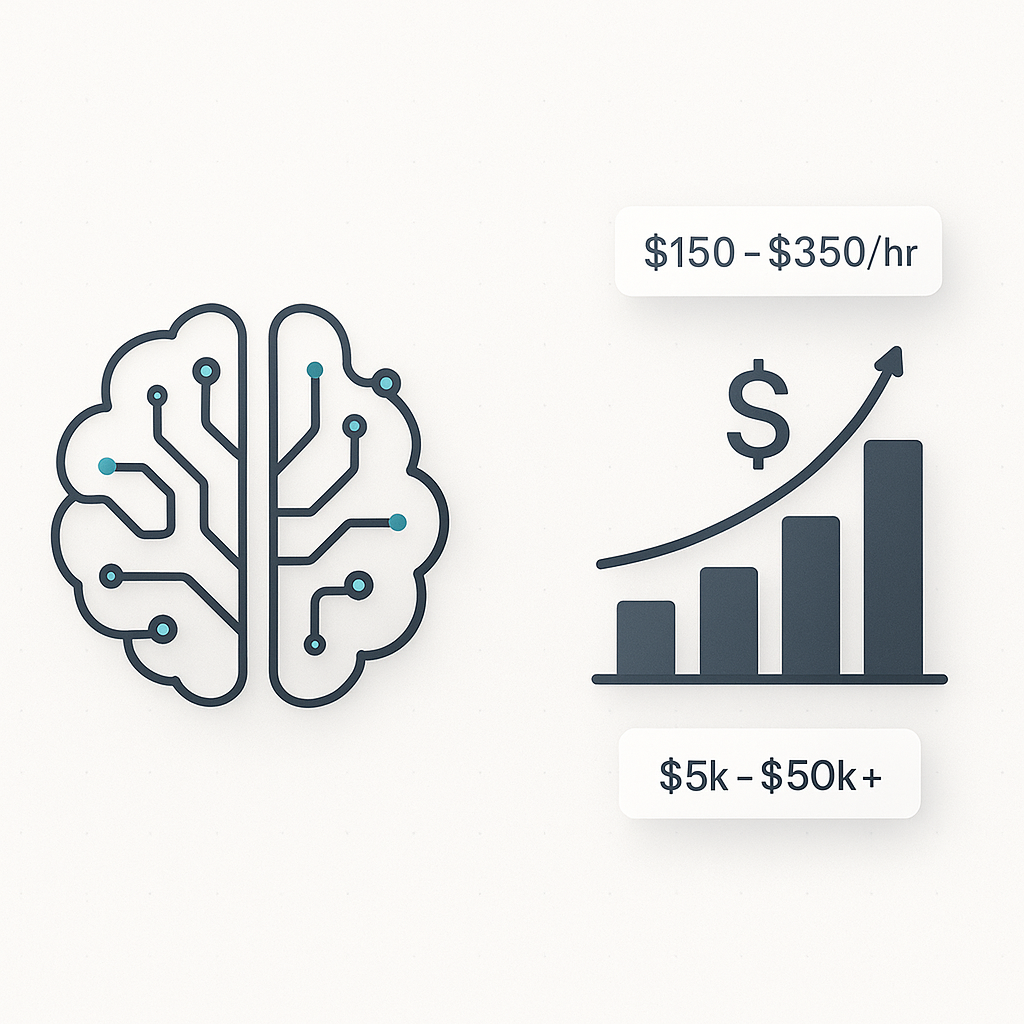
For 2026, experienced independent AI consultants often land somewhere around $150-$350 per hour. Scoped project work commonly ranges from a few thousand dollars to $50,000+ depending on systems, complexity, and rollout support.
At Leaf Lane, we try to make that easier to buy. Follow-on consulting is priced from a $225/hr baseline, with practical minimums so the work includes discovery, testing, documentation, and handoff instead of only meetings.
Leaf Lane's current pricing model
Our current services pricing uses four simple anchors:
- Baseline rate: $225/hr for advisory, scoping, implementation, review, testing, documentation, and handoff
- Build minimum: $2,500 so small builds have enough room for a real setup and clean finish
- First workflow sprint: usually $3,500-$7,500 for one focused workflow once the target problem is clear
- Ongoing advisor: starts at $2,500/mo for businesses that want a steady AI and technology operating rhythm
Those numbers are not meant to make every project fit a fixed package. They are meant to give buyers a realistic starting point.
A short advisory call should not turn into a bloated project. A workflow build should not be sold so cheaply that there is no time to test it, document it, or hand it off. A retainer should only make sense when there is enough recurring decision support or improvement work to use it well.
You can see the current service ranges on our services page.
Start with the job you need done
A lot of buying mistakes happen because companies ask for "AI consulting" when they actually need one of a few different things:
- A fast outside perspective on a specific workflow or tool decision
- A structured assessment before choosing what to improve or automate
- A small implementation sprint for one workflow
- Ongoing advisory help as tools, vendors, and internal processes change
Those jobs should not all be priced the same way.
If your team already knows the problem and mostly needs direction, hourly advisory may be enough. If the scope is fuzzy, a diagnostic assessment or short discovery project usually makes more sense. If the work touches real systems and people, expect a project minimum. If you need a regular operating rhythm, a retainer may be cleaner than restarting the conversation every few weeks.
When hourly work is reasonable
Hourly consulting works best when the question is narrow and the internal owner is clear.
Good examples:
- reviewing a call-handling workflow before your team rebuilds it
- pressure-testing whether a reporting use case is worth doing
- deciding whether a tool fits your current process
- troubleshooting a weak handoff between intake and fulfillment
- reviewing a prompt, automation, SOP, or draft workflow before launch
The upside is flexibility. You can get good judgment without committing to a build.
The risk is drift. If hourly work becomes a string of meetings with no owner, no implementation path, and no definition of done, it can cost more than a small scoped sprint.
That is why we prefer to connect hourly work to a decision: keep, stop, scope, build, or delegate.
Why small builds need a minimum
A useful AI workflow is rarely just the automation step.
Even a simple build usually needs:
- discovery around the real workflow
- access and data boundaries
- input and output design
- human review points
- testing with messy examples
- documentation for the person who will own it
- a handoff plan for what happens after launch
That is why Leaf Lane uses a $2,500 build minimum and usually scopes first workflow sprints around $3,500-$7,500.
Below that level, it is easy to build something that demos well but fails in ordinary use. The workflow may not handle exceptions. The owner may not know how to maintain it. The team may not trust the output. The result is not cheaper implementation. It is unfinished implementation.
When a retainer makes sense
A retainer makes sense when the business needs continuity.
That usually means there are recurring decisions and small improvements around:
- which AI tools to keep, replace, or ignore
- where automation should stop for human review
- how launches are performing after the first week
- which workflows should become SOPs or skills
- what changed in the market, model landscape, or vendor stack
- how managers should support adoption without turning everything into training theater
Our ongoing advisor option starts at $2,500/mo because it reserves capacity for both advice and light implementation support. It is not meant for someone who only needs one question answered. It is better for a business that wants a monthly operating rhythm around AI, automation, and systems work.
What changes the price
The biggest pricing drivers are usually practical, not mysterious.
Scope clarity
A clear scope lowers risk. "Help us use AI" is expensive because it hides discovery, decision-making, and rework. "Reduce estimate turnaround time by improving intake, draft generation, and follow-up across our inbox and CRM" is much easier to price.
A clear scope names:
- the workflow being changed
- the systems involved
- who owns the process now
- what success looks like
- what is out of scope
Systems complexity
A clean setup with one team, one shared inbox, and a reliable CRM is cheaper to work on than a stack with scattered records, duplicate tools, and undocumented handoffs.
Complexity often shows up in:
- multiple calendars or inboxes with unclear ownership
- CRM records that are incomplete or unreliable
- approval steps that exist in practice but not in documentation
- compliance or privacy constraints
- several teams touching the same ticket, estimate, invoice, or customer handoff
Rollout support
A workflow that nobody uses is wasted money.
If the project needs training, documentation, role changes, manager follow-up, or ongoing monitoring, that should be part of the budget. Cheap proposals often leave that work out, which makes the first invoice look better and the actual outcome worse.
What different budgets can buy
Here is a practical way to think about budget size.
A few hundred dollars can buy a narrow guide, review, or strategy call. That is useful when you need direction but are not ready to build.
Around $1,000 can buy a structured diagnostic. Our AI Assessment is normally priced at $1,000, with a limited-time free offer currently available through checkout. It is meant to help you decide what to improve, automate, or ignore before committing to implementation. Details are at leaflane.co/ai-assessment.
Around $2,500 can support a small build or tightly scoped implementation minimum.
Around $3,500-$7,500 can usually support one focused workflow sprint: intake, follow-up, reporting prep, proposal drafting, SOP capture, lightweight internal tooling, or another contained process.
A $2,500/mo+ retainer is better when the work is ongoing: monthly prioritization, launch review, tool decisions, small improvements, and support for the team using the workflows.
Larger budgets make sense when the project crosses several teams, touches core systems, or needs deeper change management.
How to judge ROI before you hire
Before you commit, estimate the economics of one workflow.
Start with:
- current time cost: hours per week x loaded hourly rate
- error or rework cost: frequency x cost per incident
- revenue impact: faster cycle times, better conversion, higher throughput
- implementation cost: consulting fees, tools, and internal coordination time
Use conservative assumptions. If the work cannot plausibly pay back in an acceptable time frame, narrow the scope.
A service team that spends 15 hours a week drafting follow-ups, updating CRM notes, and preparing estimates may not need a huge transformation project. It may need a reviewed draft workflow, better intake structure, and clear handoff rules. In that case, the question is not whether the consultant charges $200 or $300 an hour. The question is whether the workflow saves enough time, reduces rework, and moves revenue faster.
A simple next step before asking for quotes
Write down the first workflow you want fixed in plain language.
Include:
- where work starts
- where it stalls
- which tools are involved
- who reviews or approves it
- what errors or delays happen now
- what result would make the project worth doing
That will improve the quality of every quote you get.
If you want the fastest, lowest-commitment starting point, use the AI Quick Start Guide at leaflane.co/ai-quick-start-guide. If you want a reviewed diagnostic with recommendations and a walkthrough, start with the AI Assessment at leaflane.co/ai-assessment. If the workflow is already clear and you are ready to scope implementation, use the services page at leaflane.co/services.
The useful next move is not to compare rates in isolation. It is to define one workflow clearly enough that you can tell whether outside help will save time, reduce errors, or move work through the business faster.