AI Implementation Consultant vs In-House AI Team: A Practical Decision Framework
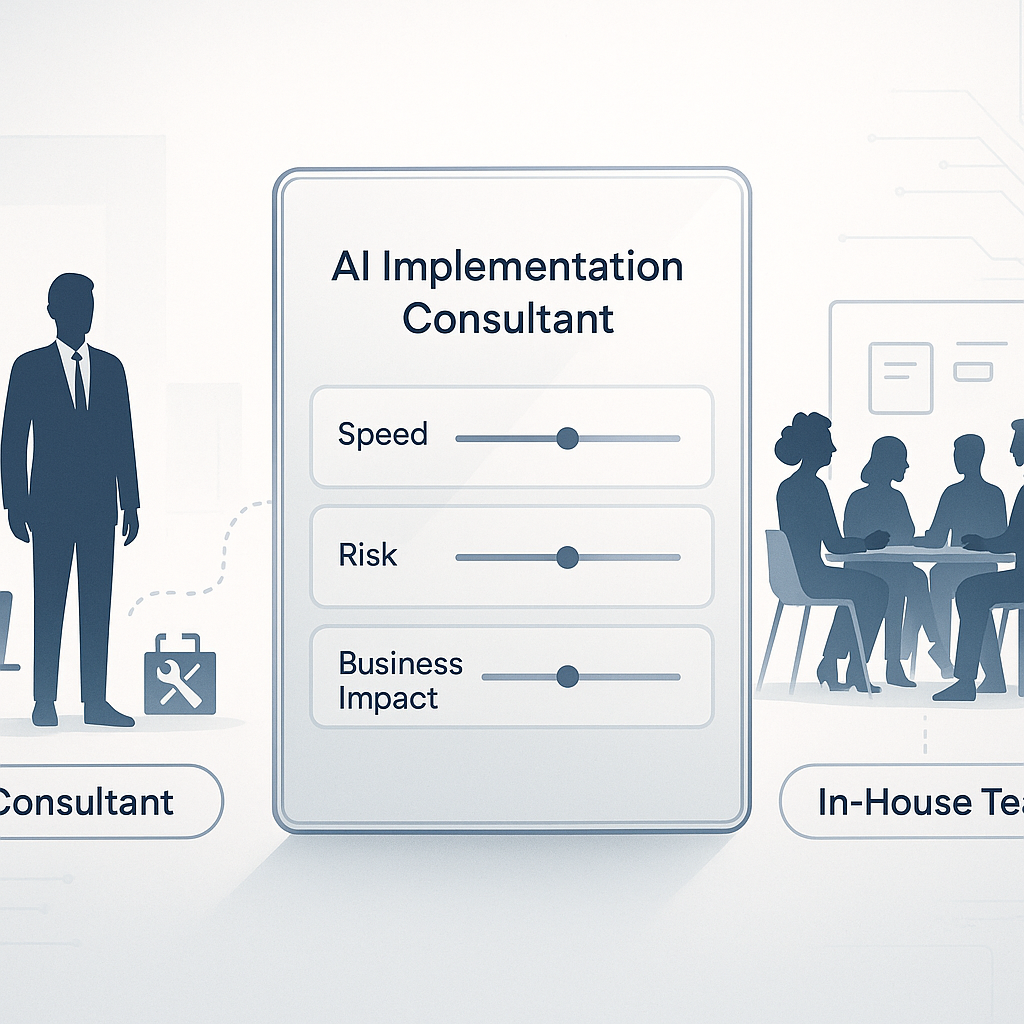
Most teams start this decision in the wrong place. They ask who should build the AI work. The more useful question is simpler: what capability do you need working in the next 90 days, and what level of risk can your business absorb while you build it?
That shift matters because consultant versus internal team is not a belief system. It is a sequencing choice. In many companies, the strongest path is a hybrid one: bring in outside help to reduce early mistakes, while building internal ownership from the first week.
If you are considering an implementation partner, start with operating constraints rather than headcount plans. At Leaf Lane, we usually look at three things first:
- Time-to-value: how quickly do you need a measurable result?
- Change capacity: how much process change can your team handle this quarter?
- Decision bandwidth: do leaders have time to unblock weekly choices?
If your honest answers are "fast," "limited," and "not much," an external implementation partner often performs better in the first phase than a newly assembled in-house effort.
Start with the workflow, not the org chart
This decision gets easier when you stop treating AI as a department and start treating it as a workflow problem.
For example:
- Are inbound calls being missed and never making it into the CRM?
- Are estimates sitting in inboxes for days because nobody owns the handoff?
- Are support tickets piling up because triage is inconsistent?
- Are calendars, SOPs, and reports spread across too many systems?
Those are implementation questions. They involve process design, data access, approvals, training, and review loops. The team structure should follow the problem, not the other way around.
A consultant can help if the workflow is stuck and nobody internally has done this kind of deployment before. An internal team has the edge when the real issue is deep company context and ongoing iteration.
Where consultants usually win
Experienced consultants tend to be strongest in the first stretch, when speed and clarity matter most.
They bring delivery patterns your team may not have yet. That can save weeks of avoidable trial and error around model choice, workflow design, guardrails, rollout sequencing, and quality checks. If your team has never deployed production AI workflows before, this matters.
They also force scope discipline. Internal teams often start with broad goals like "automate support" or "improve productivity." A good consultant narrows that into one workflow with a baseline, a success metric, and a named owner.
That kind of narrowing is practical. Instead of trying to "improve sales operations," the project becomes something like:
- Draft follow-up emails after sales calls
- Summarize estimate requests into the CRM
- Route service tickets by urgency and category
- Pull invoice exceptions into a weekly review queue
Consultants can also help cross-functional teams use the same definition of done. Many projects slow down because operations, legal, leadership, and technical staff all picture different risks and different outcomes. Someone who has run similar projects can shorten those decision loops.
Finally, outside teams often have a stronger launch rhythm. Pilot structure, training cadence, change communication, and measurement matter more than many teams expect. Early trust is usually won or lost there, not in a technical demo.
Where in-house teams usually win
Internal teams have context that outsiders will never fully absorb.
They know the edge cases in your calls, calendars, ticket routing, customer records, and reporting. They know which fields in the CRM are always messy, which SOPs people actually follow, and which exceptions trigger customer complaints. That context becomes more important as you move from pilot to routine use.
In-house ownership also tends to improve long-term economics. Once a workflow is stable, your own team can usually iterate faster and at lower ongoing cost than repeated consulting engagements.
There is also a practical trust advantage. Employees are often more willing to adopt a new process when a peer owns it. A team lead in operations who can explain why a handoff changed will usually get more buy-in than an outside advisor presenting a slide.
If your company expects continuous AI improvement, internal capability is necessary. Someone on your side needs to monitor quality drift, review failures, update prompts or logic, and align the workflow with business priorities as they change.
The cost of getting the sequence wrong
The biggest mistake is not choosing one side or the other. It is choosing the wrong order.
Starting in-house too early can stall momentum. A company hires one technical person, gives them a vague mandate, and assumes the work will sort itself out. Six months later, there are promising demos, but no reliable effect on calls handled, tickets resolved, quotes sent, or cycle time reduced.
Starting with consultants and no transfer plan creates a different problem. The project launches, but your team cannot maintain it. The workflow breaks when something changes, and nobody internally knows how to adjust it.
The issue is not the use of consultants or employees by itself. The issue is treating either option as permanent when the business actually needs a phased approach.
A practical 90-day decision model
Use this model to decide where to start:
- If you need measurable impact inside one quarter, start consultant-led.
- If you already have an AI-capable product and operations pair who can own implementation, you can start in-house.
- If the workflow touches sensitive data, regulated decisions, or brand-critical customer interactions, bring in expert guidance early even if execution is mostly internal.
Then make the handoff plan before kickoff, not after launch.
Define these items up front:
- Internal owner for each workflow
- Documentation standard and runbooks
- Weekly shadowing for your team
- Exit criteria for consultant involvement
This avoids the common vendor cliff where progress drops as soon as the engagement ends.
What a workable hybrid model looks like
A practical hybrid structure is usually less complicated than people expect.
- Consultant leads architecture and the first implementation sprint
- Internal operations owner defines the workflow and acceptance criteria
- Internal technical owner co-builds prompts, evaluations, and monitoring
- Leadership reviews one business KPI and one quality KPI each week
That review rhythm matters. If leadership only checks for activity, projects drift. If they review one business outcome and one quality measure, the team can make tradeoffs faster.
For example, a service business might track:
- Business KPI: faster estimate turnaround or fewer missed calls
- Quality KPI: accuracy of summaries entered into the CRM
By weeks 6 to 8, internal owners should be running most of the weekly execution rhythm. By weeks 10 to 12, consultants should mostly be handling escalation and specialized guidance.
Budget and ROI are usually misread
Many teams compare consultant fees to salary cost and conclude that in-house is cheaper. That is too narrow.
Real cost also includes:
- Delayed value while hiring and ramping
- Wrong architecture or workflow choices
- Failed adoption because process design was weak
- Opportunity cost of waiting one or two quarters for useful execution
If a consultant-led sprint creates reliable value within 60 to 90 days, that speed can matter more than the apparent savings of a slower internal start.
The right comparison is not consultant fee versus salary. It is time-to-value, failure risk, and your ability to keep the workflow running after the first release.
Signs you should bring in outside help now
A few patterns usually signal that internal momentum is not enough yet:
- Your team keeps debating tools instead of shipping workflows
- Pilots exist, but nobody can show business impact
- Outputs are inconsistent and trust is slipping
- Leaders agree on ambition but not on the operating model
- Work is happening in silos across inboxes, tickets, CRM records, and reports without a clear owner
When those signs show up, outside help is often less about outsourcing and more about improving implementation quality and speeding up decisions.
Make the choice based on ownership after launch
A good test is this: who will review failures, update the SOP, adjust the workflow, and answer questions from the team three months after go-live?
If you do not know, you are not ready to rely only on consultants.
If you know the owner but they lack implementation experience, a consultant can help them get to a stable first version faster.
That is usually the practical answer. Use outside expertise to reduce early risk and get the first win. Build internal ownership from the beginning so the workflow does not become a black box. Then shift control to your team once the process is stable, documented, and measurable.
If you are deciding now, pick one workflow with a clear owner, a baseline, and a weekly review loop. The better choice between consultant and in-house team usually becomes obvious when the work is specific enough to measure.