AI Search Visibility Starts With Clear Public Facts
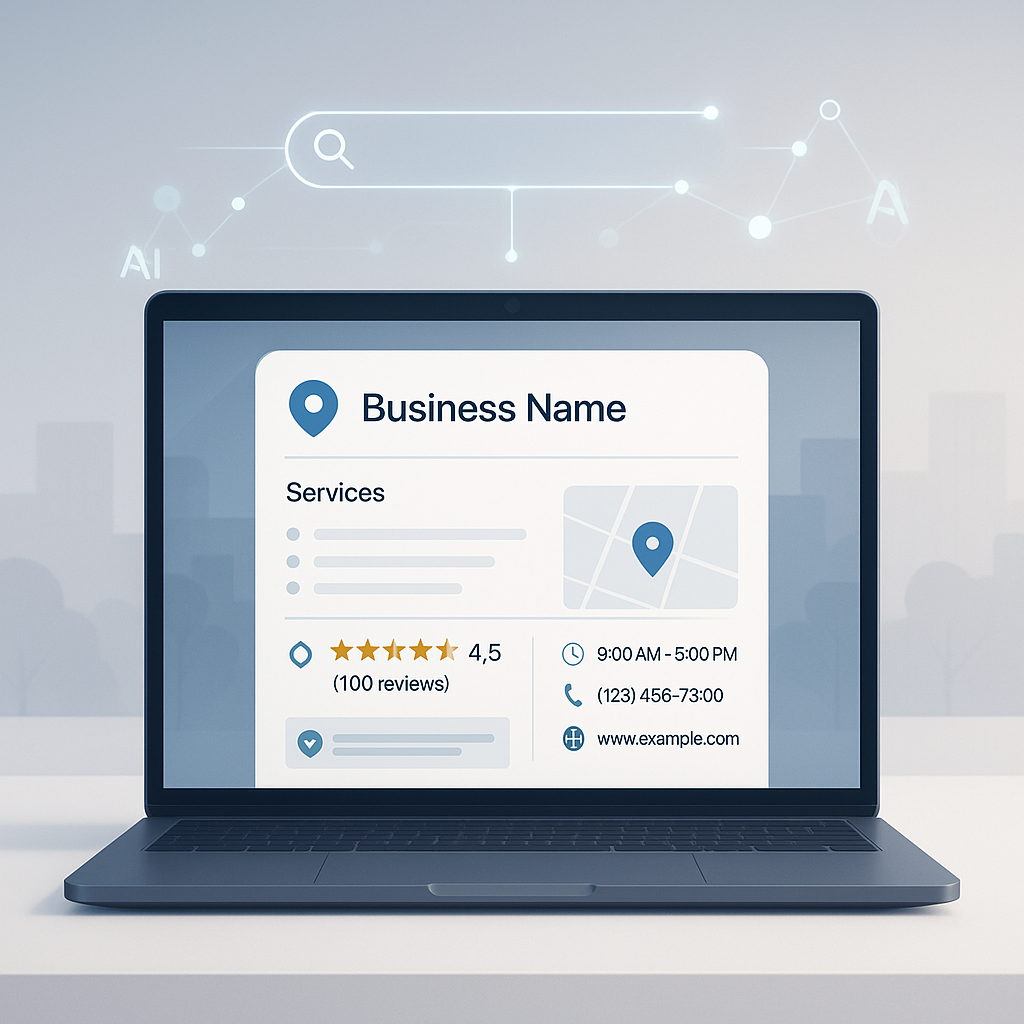
Customers are changing how they look for local businesses.
Some still type a short phrase into Google. Others ask a longer question in an AI search experience: who handles emergency HVAC near me, which accountant works with restaurants, what dentist is good with anxious patients, which consultant can help a small team clean up its software stack.
For a local business, that creates a simple operating problem. A person or system needs to understand what you do, where you do it, who you help, why you are credible, and what the next step is.
Many businesses make this harder than it needs to be. The facts are spread across an old homepage, thin service pages, an outdated Google Business Profile, directory listings, review sites, and social profiles. Reviews mention work the site barely explains. Hours differ by platform. Phone numbers and service areas drift.
If a search system has to assemble your business from fragments, it may miss the strongest version of what you actually offer.
Start with facts, not tactics
Most local businesses do not need a brand-new AI search strategy. They need cleaner public information.
A practical first step is a public fact audit. Pull together the pages and profiles a customer or search system is likely to see first:
- homepage
- service pages
- location pages
- Google Business Profile
- review pages
- directory listings
- social profiles
- recent articles, FAQs, and case studies
- third-party mentions
Then check a short set of questions:
- Are services clearly named?
- Are service areas and locations clear?
- Are customer types or industries named?
- Does the site explain the problems you solve?
- Is there public proof such as reviews, photos, credentials, project examples, or articles?
- Do facts conflict across pages?
- Are important services showing up in reviews and calls but not on the site?
This is basic operating hygiene. It matters because customer questions are getting more specific. The query may not be plumber near me. It may be who can replace a water heater this week and explain the options clearly.
Clear public evidence helps with that kind of search.
The useful output is a decision list
A visibility review should lead to decisions, not a vague SEO memo.
A good review usually produces:
- one list of public facts: business name, categories, locations, service areas, phone number, hours, booking path, primary services, and credibility signals
- a gap list showing what a customer still cannot tell from public pages
- a conflict list showing where sources disagree
- a service page map showing which services have strong pages, weak pages, or no page
- a review-language summary showing how customers describe the work
- a short priority list of pages and profiles to update first
- a human approval checklist before anything changes publicly
That last item matters. AI can compare records, summarize review patterns, and draft updates. A person still needs to confirm service boundaries, claims, availability, hours, and promises.
For example, reviews may repeatedly mention emergency repairs while the site only says residential plumbing. That is useful evidence. It is not a reason to publish 24/7 emergency plumbing unless the business actually offers it.
What search platforms are actually saying
The basic guidance from Google and OpenAI points in the same direction.
Google says the fundamentals still matter for AI features: pages need to be eligible for Search, technically accessible, and built around helpful, reliable content. Google also says there is no special AI-only markup required for AI Overviews or AI Mode.
For local businesses, Google Business Profile guidance remains very practical. Complete business information, current hours, reviews, photos, relevance, distance, and prominence all affect how local results are understood.
OpenAI says ChatGPT Search uses web sources and local context for relevant answers, but there is no guaranteed placement. If a business wants to be available to ChatGPT Search, its site needs to allow OAI-Searchbot to crawl it.
The practical takeaway is not to optimize for one tool. It is to make accurate public facts easier to crawl, understand, verify, and connect.
A simple audit a local business can run
You can do a first pass without turning it into a large project.
Inventory the public surface
List the main places a customer might land first:
- homepage
- top service pages
- location pages
- Google Business Profile
- major directories
- review profiles
- social profiles
- recent articles or FAQs
Extract the facts
Capture the details that shape a buying decision:
- business name
- address or service area
- phone number
- hours
- categories
- services
- industries served
- booking path
- key claims
Check for conflicts
Look for common problems:
- mismatched hours
- old phone numbers
- outdated service names
- dead booking links
- stale photos
- categories that no longer fit
Compare with real customer language
Review calls, emails, intake notes, and reviews. Customers often explain your value more directly than your website does.
If customers ask for same-day repair and your page says quality service, the page is probably under-explaining what matters.
If reviews keep mentioning great with anxious patients and a dental office never says that on its site, that is another useful gap.
Prioritize the pages that answer buying questions
Do not rewrite everything first. Start with the pages that answer high-intent questions:
- what you do
- where you do it
- who you help
- how pricing works, if you can share it
- what happens next
- what proof supports the claim
Structure helps when facts are already clear
For local businesses, LocalBusiness structured data can help identify hours, address, phone, departments, and other facts for eligible Google search features.
It is not a ranking switch. It is a way to reduce ambiguity.
That only helps if the underlying facts are right. If the homepage says one thing, the profile says another, and the schema says a third, structured data will not fix the underlying confusion.
This is a good candidate for a repeatable workflow
The repeatable parts of this work fit well into a documented skill or light automation.
A team can define:
- which sources to inspect
- which fact fields to extract
- how to compare records
- how to summarize review language
- what the output should look like
- where human approval is required
A lighter automation can then run on a schedule and flag issues such as:
- key pages changed
- new reviews mention services the site does not explain
- hours or phone numbers appear inconsistent
- booking links are broken
- customer questions point to missing FAQ or article topics
That can feed a simple review loop for the owner, operator, or marketing lead: here is what changed, here is what conflicts, here is what customers are asking, and here is what should be reviewed next.
The next move is usually smaller than people expect
Most businesses do not need an AI search project. They need one clean pass through the public facts that shape visibility and trust.
If your service pages, profiles, reviews, and structured data all say roughly the same thing, search systems have less guesswork to do. More importantly, customers have less guesswork to do.
Start with your top five public surfaces and one question: if a stranger saw only these, would they understand the business well enough to call, book, or ask for an estimate?
Source notes
OpenAI Help Center: ChatGPT Search
Google Search Central: AI features and your website
Google Search Central: LocalBusiness structured data
Google Business Profile Help: Tips to improve your local ranking on Google