Harness Engineering Is the New Product Surface for AI Teams
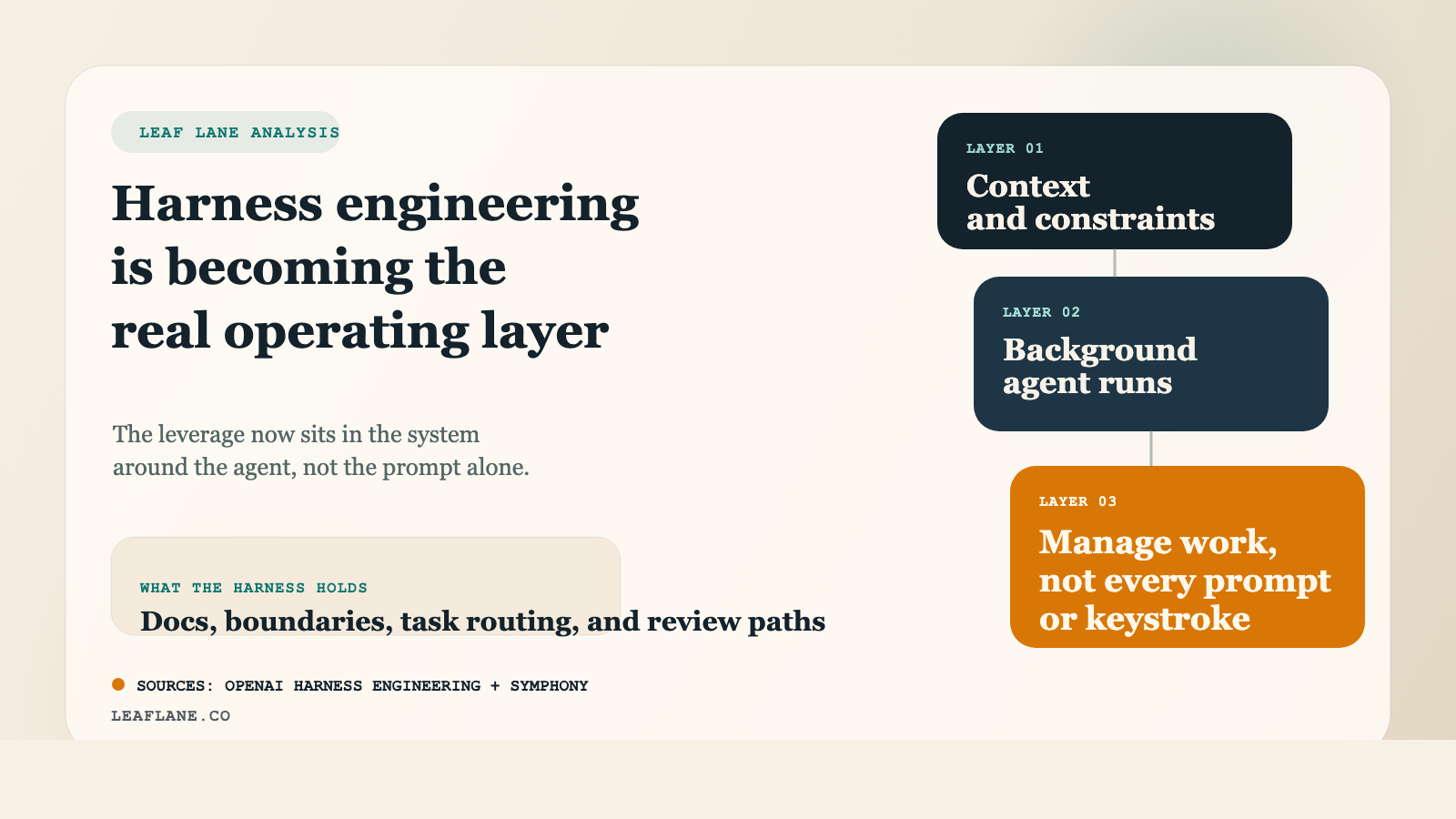
Most teams still evaluate AI work as if the prompt is the product.
That is becoming less useful, especially for teams trying to ship software work through agents instead of using models for one-off answers.
OpenAI's recent post on harness engineering helps because it names the actual operating problem. In its write-up, OpenAI describes building and shipping an internal beta product with no manually written application code, using Codex for execution and humans for steering. The interesting part is not the headline. It is the setup around the agent.
The team improved output by building a working environment the agent could operate inside: repository rules, architecture constraints, feedback loops, review habits, and a system of record the model could inspect. That is a more practical lens for business and engineering teams than endless prompt tuning.
The bottleneck moves from the model to the working environment
Once models are capable enough, a different limit shows up.
The issue is no longer only whether the model can write code, summarize a spec, or propose a fix. The issue is whether the surrounding system gives the model enough context, enough structure, and enough checks to do that work repeatedly without creating cleanup.
That is what harness engineering points to.
A harness is the environment around the agent that makes useful behavior easier and risky behavior harder. It includes the prompt, but it also includes:
- where the agent gets context
- what files, rules, and conventions it can inspect
- how tasks are scoped
- what permissions it has
- how output is reviewed
- what tests, linters, or validation rules run before changes land
- how feedback from one run improves the next one
For a business owner or team lead, this should sound familiar. Most operating problems are not caused by one bad employee instruction. They happen because the handoff is vague, the system of record is incomplete, and review happens too late.
The same pattern shows up with agents.
OpenAI's post reframes the engineer's job
One useful point in OpenAI's article is the role shift.
In an agent-first workflow, the human is spending less time typing every implementation detail and more time setting intent, constraints, and review rules. The work moves upward.
That does not make engineering judgment less important. It makes system design more important.
A team lead still has to decide:
- what done means
- what the agent is allowed to change
- what architecture boundaries matter
- what needs human review
- what should be caught automatically
- what information belongs in docs instead of chat history
This is similar to what happens in operations when a company tries to reduce back-and-forth in estimates, tickets, invoices, or CRM updates. If every exception lives in one manager's head, the process does not scale. If the process is explicit, other people and systems can execute it with fewer interruptions.
Agent workflows are no different.
If the agent cannot find the rule, the rule does not exist
OpenAI also makes a practical point about repository legibility.
If a key architectural decision lives in Slack, in a meeting, or in somebody's memory, the agent cannot reliably use it. For an agent, undocumented knowledge is usually missing knowledge.
That matters more than many teams expect.
A lot of software groups still run on scattered context:
- naming conventions in old pull requests
- review preferences passed around informally
- edge cases buried in tickets
- undocumented dependencies between services
- assumptions that only make sense if you were there two years ago
Humans can sometimes work around that. Agents usually turn it into drift.
This is why better documentation is not only a people issue anymore. It is part of the execution layer.
The same idea applies outside software teams too. If your sales assistant has to guess which inbox label matters, or your operations coordinator cannot tell which spreadsheet is current, you do not have an automation problem first. You have a system-of-record problem.
Strict boundaries help earlier than most teams think
Another practical point from the OpenAI post is structure.
The write-up describes explicit layers, custom linters, structural tests, and encoded taste invariants. Human teams often delay this kind of discipline until the codebase becomes painful. Agents make the need show up sooner.
Why? Because speed without boundaries produces more mess, faster.
When an agent can make many changes quickly, small ambiguities become recurring defects. Clear structure acts like guardrails:
- layer boundaries reduce random cross-system changes
- linters catch style and consistency issues before review
- structural tests prevent fragile shortcuts
- encoded rules reduce repeated reviewer comments
This is not very glamorous, but it is how teams reduce waste.
The business version is straightforward. If you want someone to handle estimate follow-up, ticket triage, invoice matching, or CRM cleanup, you need clear rules about what goes where, what gets flagged, and what requires approval. Otherwise speed turns into rework.
Why Symphony matters
This is where Symphony becomes relevant.
Symphony is an open-source background coding agent platform from OpenAI. The important idea is not simply that an agent runs in the background. The point is that software work gets packaged into isolated runs so teams can manage work without supervising every coding step in real time.
That is a harness concept.
As the README describes it, Symphony starts from issues, bug reports, or prompts, hands work to background agents, and layers in review and automation around those runs. That treats the agent less like a chatbot and more like a worker operating inside a managed system.
For teams, that is a better mental model.
Most organizations already know how to manage work items, review loops, and quality checks. The challenge is that many are still using strong models inside weak operating systems:
- requirements are underspecified
- context is fragmented
- ownership is fuzzy
- verification happens late
- review rules vary by person
- feedback does not get turned into reusable constraints
When that happens, results disappoint for predictable reasons. The model may be capable, but the setup around it is not ready.
The real advantage is in the interface between people and agents
Put OpenAI's harness engineering post beside Symphony and a clearer pattern shows up.
The useful advantage is moving up a level.
It is less about finding the best prompt in isolation and more about building a stable interface between human judgment and agent execution.
That interface includes:
- discoverable system knowledge
- explicit task boundaries
- repository conventions the agent can follow
- verification before high-impact changes
- review paths that improve future runs
- tooling that makes the preferred behavior the default
This is why harness engineering is a more useful term than prompt engineering for many teams.
Prompting still matters. But it is one control surface inside a broader working system.
What business and engineering leaders should check first
If you are deciding where to invest, start with the workflow, not the model.
Ask practical questions:
- Where does the agent get the current source of truth?
- What rules exist only in meetings, chat, or memory?
- What kinds of changes should always trigger review?
- What validation can happen automatically before a human touches the output?
- Where does feedback from reviewers get written down so the next run improves?
- Which handoffs are creating the most cleanup today?
A simple test helps: imagine an agent had to execute the work exactly as your system exists right now.
Would it find current documentation? Would it know which repo, ticket, or environment to use? Would it know what counts as complete? Would it run the right checks before handing work back?
If the likely answer is confusion and cleanup, your first investment probably should not be a better prompt.
It should be the harness.
That means tightening systems of record, making conventions visible, defining approval paths, and turning repeated reviewer comments into rules the agent can actually use.
Read OpenAI's "Harness engineering: leveraging Codex in an agent-first world" and the Symphony project with that lens. The practical next step is not to ask whether agents are good enough. It is to pick one repeated workflow and make the environment around it legible enough that an agent can work there without constant rescue.