The Agent Infrastructure Gap Is the New Product Surface
Most teams still talk about AI performance as if it lives inside a better prompt. In practice, that is no longer where projects stall.
What now slows real adoption is infrastructure: memory that survives sessions, tool access that is predictable, handoffs between specialized agents, safe execution boundaries, and deployment models that non-technical teams can actually run.
Across operator conversations this week, the same pattern appeared from different angles. People are not asking for another clever prompt. They are asking for systems that do not collapse under normal use.
The shift is subtle but important: prompts are becoming table stakes, while operating architecture is becoming the differentiator.
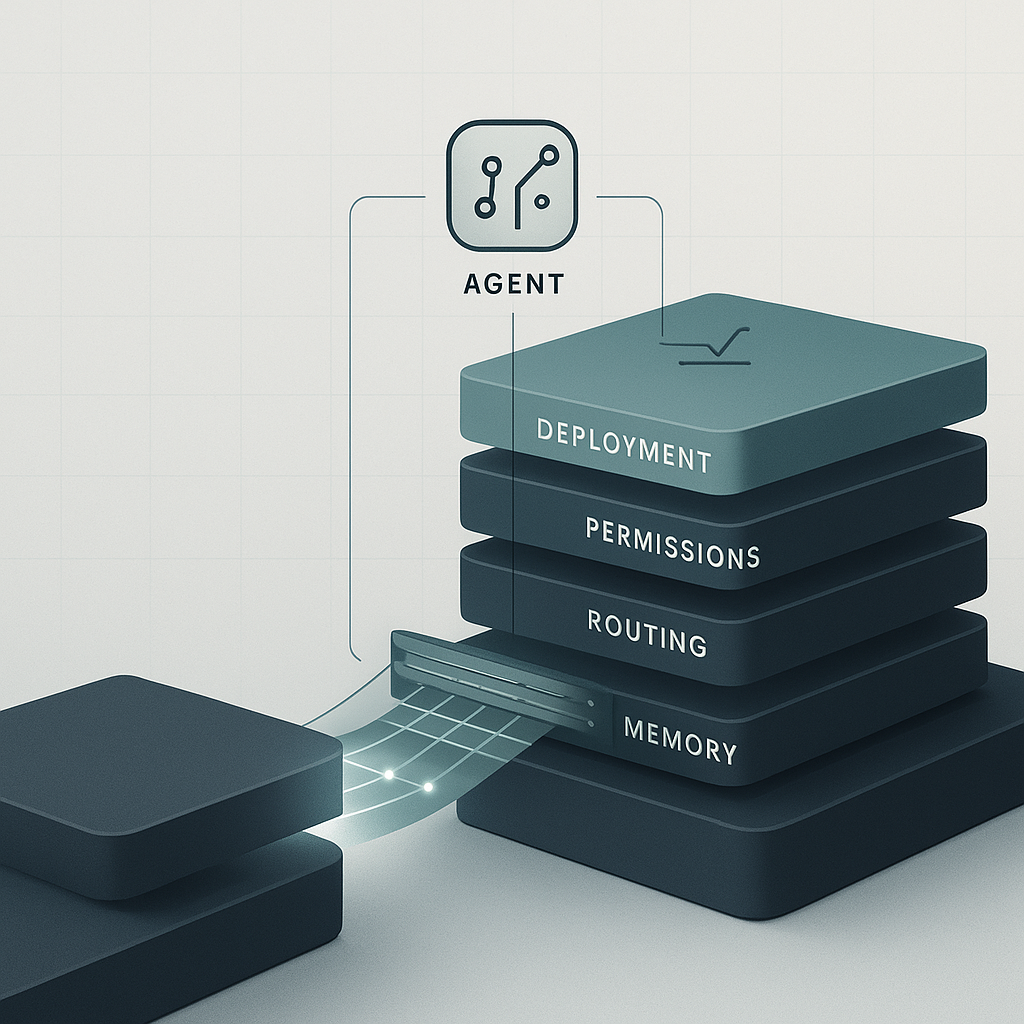
A useful way to frame the current stack is four layers.
Layer 1 is reasoning quality. This is still necessary, but no longer sufficient.
Layer 2 is context plumbing: memory models, retrieval behavior, and how state is carried across tasks.
Layer 3 is action rails: what the agent can do, under what permissions, with what observability and rollback.
Layer 4 is operational packaging: multi-tenant reliability, onboarding speed, and maintainability for teams that are not full-time AI engineers.
Most failures in production happen in Layers 2 to 4, not Layer 1.
This is why the current generation of agent work increasingly looks like platform engineering. Teams are standardizing tool contracts, defining guardrails, and building repeatable runbooks instead of endlessly tuning wording.
Open standards are accelerating this shift. Anthropic’s Model Context Protocol positions tool and context connectivity as a standard interface, not one-off glue code. OpenAI’s current agent tooling similarly emphasizes orchestrated tools, memory, and control flow over prompt-only optimization.
That is a signal for operators: the ecosystem is moving toward system design as the primary leverage point.
If you are building with agents today, three practical moves matter more than another prompt sprint.
First, design your memory policy intentionally. Decide what should persist, what should expire, and what should be immutable audit history. Most teams either over-store noisy context or lose essential state between runs.
Second, make tool boundaries explicit. Every tool should have clear inputs, safe defaults, and human-readable failure states. Ambiguous tool contracts create silent drift and brittle behavior.
Third, choose a deployment posture early. Single-user prototypes hide the hardest problems. Multi-tenant access control, queueing, retries, and monitoring are where real complexity appears.
The teams that win this phase will not be the ones with the most elaborate prompts. They will be the ones that treat agent infrastructure as a product surface: designed, tested, and iterated with the same rigor as customer-facing software.
In short, the market is moving from prompt engineering to agent operations engineering. That is where durable advantage now lives.