How to Get Useful Help With AI Without Buying Hype
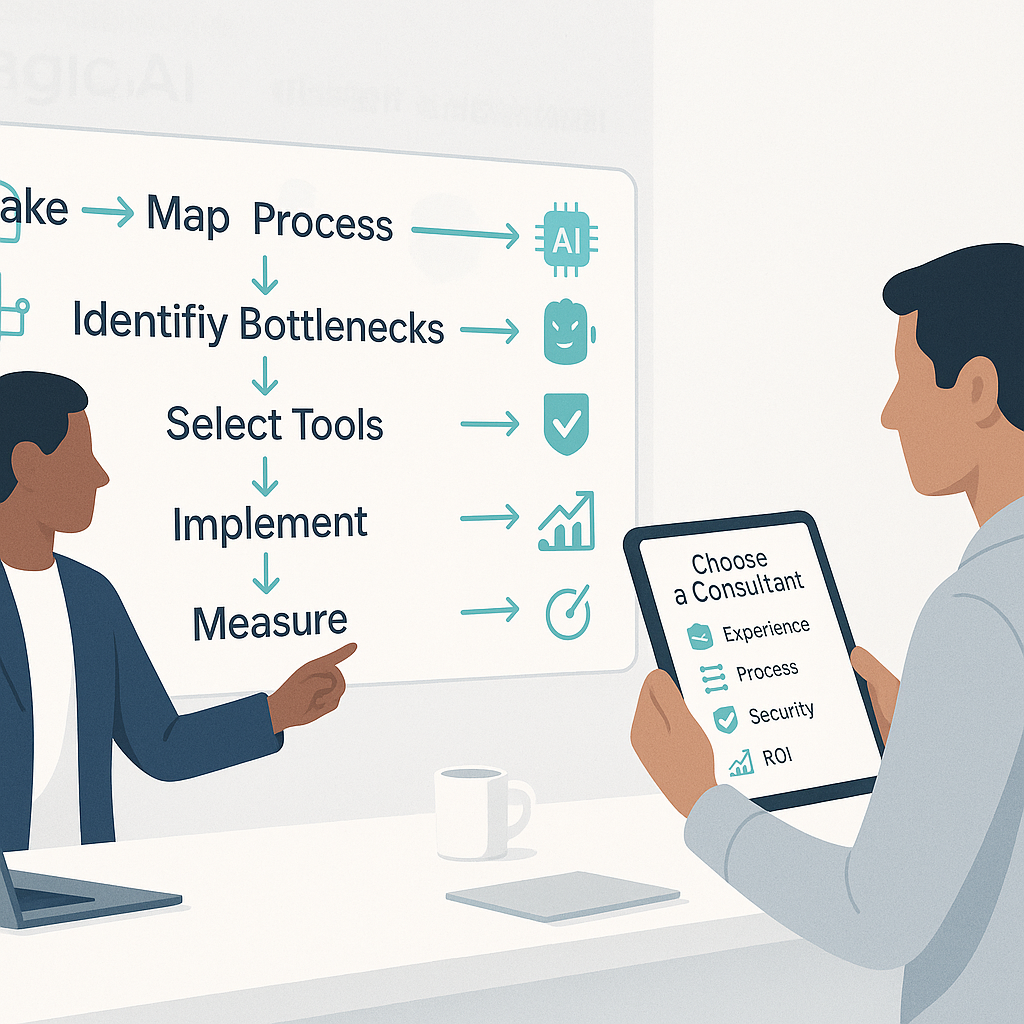
There is a lot of noisy advice in AI right now.
Some of it is useful. A lot of it is dressed-up certainty.
If you want help with AI, the main question is not who sounds smartest. It is who can make the work easier to run.
That means less time lost in inbox triage, calendar back-and-forth, estimate follow-ups, CRM cleanup, ticket routing, invoice processing, and all the other small repeat jobs that quietly eat a week.
Start with the work, not the tool
Useful AI help usually starts with your workflow.
Before recommending anything, a good advisor should want to understand how work actually moves through your business.
- What tasks repeat every day or every week?
- Where do handoffs break?
- Where do calls, notes, or requests get dropped?
- What takes too long to draft, sort, check, or send?
- Where are people copying information between systems by hand?
- What feels slightly ridiculous to still be doing in 2026?
That is a better starting point than a pitch about a favorite product.
If someone wants to talk tools before they understand your process, there is a good chance they are trying to fit your business into something they already planned to sell.
A grounded conversation sounds more like this:
- “How does a new lead get logged?”
- “Who owns follow-up after an estimate goes out?”
- “What happens when a customer replies by email instead of through the form?”
- “Where do reports get assembled by hand?”
Those questions usually reveal the real problem faster than technical language does.
Smaller help is often better help
Good AI support does not always lead to a large build.
Sometimes you do need a workflow, integration, or custom setup. But sometimes the useful answer is much smaller.
It might be:
- a better prompt for recurring writing tasks
- a template for intake or follow-up
- a cleaner SOP for how information gets handed off
- a simple review loop before something is sent
- better use of a tool your team already has
- a decision that a task should stay manual for now
That kind of advice shows judgment.
Hype tends to push everything toward a larger project. Real help can say, “You do not need much here. Fix the intake form, standardize the notes, and test one small automation first.”
For most small and mid-sized teams, that is often the right answer.
The human part decides whether it sticks
A tool can be technically capable and still fail in practice.
If people do not trust it, do not understand it, or do not know when to use it, the workflow usually stalls. You end up with one person trying to keep a new system alive while everyone else works around it.
That is why useful help often includes things outside the software itself:
- cleaning up a messy process before automating it
- setting expectations about what the tool should and should not do
- deciding who checks output and when
- making handoffs clear between sales, ops, service, and admin
- documenting a light SOP so the process survives after launch
This matters whether you are summarizing calls, drafting replies, categorizing tickets, updating CRM records, or assembling recurring reports.
If the people side is ignored, the project usually becomes another half-used tool.
What bad AI help usually looks like
It is worth being direct about what useful help is not.
It is not:
- a long stream of technical language you did not ask for
- a vague promise that AI will change everything by itself
- a list of recommendations with no ranking or tradeoffs
- a polished presentation that leaves you less sure what to do next
- a refusal to say when AI is the wrong answer
You should be able to walk away knowing what problem is being solved, what options exist, what the likely effort is, and what you can ignore for now.
A few questions that expose the difference
If you are evaluating a consultant, advisor, or outside expert, ask a few simple questions.
- Do they ask thoughtful questions before recommending anything?
- Can they discuss the actual work your team does each week?
- Can they explain why one option is better than another?
- Will they point out tradeoffs, risks, and review needs?
- Will they tell you when a non-AI fix is the better move?
Those answers matter more than whether someone can speak confidently about the latest model release.
If you are not ready to hire anyone yet
You can still do useful prep on your own.
For one week, write down every moment you think, this should not take this long.
Include things like:
- retyping notes after calls
- chasing missing information
- sorting the same inbox patterns every day
- building the same estimate from old files
- correcting inconsistent CRM entries
- sending the same update over and over
That list is one of the best briefs you can create.
It shows where the drag is. It gives you real examples. And it makes outside advice easier to judge because the conversation is anchored in actual work.
That is a better standard for AI help: clearer choices, less wasted motion, and a next step your team can actually use.