The AI Trust Gap Between Managers and Workers Is an Operating Risk
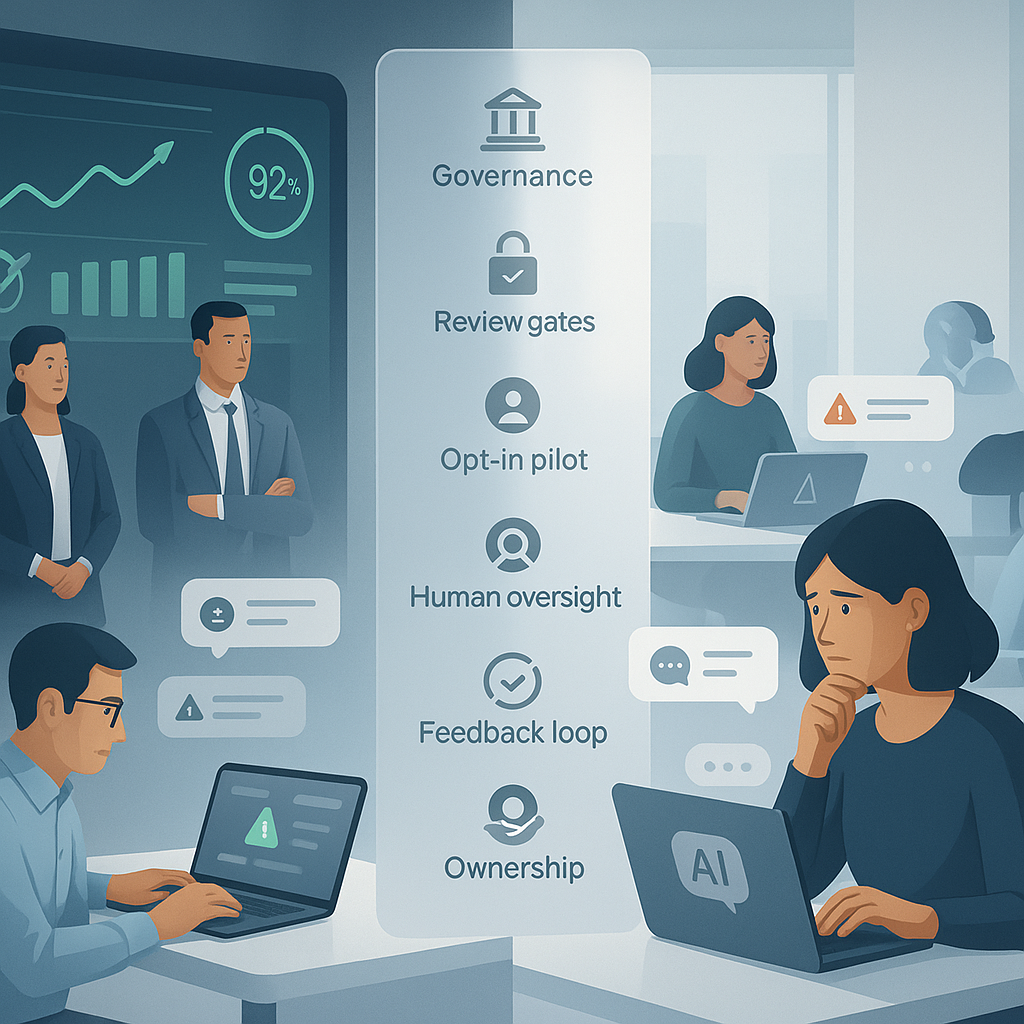
AI rollout can look fine from the manager's side while the people doing the work are still uneasy.
A dashboard might show approved tools, completed training, and a few launched pilots. But inside the inbox, the ticket queue, the estimate process, or the weekly reporting loop, employees are often asking different questions.
- Is this output accurate enough to send?
- Am I supposed to say when I used it?
- Will this tool be used to measure my work?
- If it gets something wrong, who owns that mistake?
- What happens when the system suggests something that conflicts with what I know from experience?
That gap is not a culture footnote. It is an operating risk.
When people do not trust the rollout, they usually do one of three things:
- avoid the tool entirely
- use it quietly with no shared rules
- rely on it in ways leadership did not intend
All three create management problems. You get inconsistent outputs, hidden workarounds, unclear accountability, and more review work later.
The goal is not to persuade everyone that AI is useful everywhere. The goal is simpler: make the rules, limits, and review path clear enough that people can use the tool without guessing.
Start with one workflow, not a broad rollout message
A useful trust review starts with real work.
Not a company-wide announcement. Not a slide about innovation. One workflow.
Pick something specific, like:
- drafting customer replies
- summarizing sales calls into CRM notes
- preparing meeting notes
- reviewing support tickets
- building a weekly report
- screening incoming requests
- organizing estimate details before a quote is sent
Then gather the inputs people already rely on.
That might include:
- process notes
- example emails
- call transcripts
- CRM fields
- spreadsheet exports
- customer policies
- compliance requirements
- examples of previous good work
Once the actual work is in view, ask two sets of questions.
Questions from the manager's side
- What outcome are we trying to improve?
- What risk are we trying to reduce?
- What work should the tool never do on its own?
- Where do we need human approval before anything reaches a customer, vendor, employee, or public channel?
- What evidence would show this workflow is helping?
Questions from the worker's side
- What part of the job is already sensitive, ambiguous, or relationship-heavy?
- Where would a wrong answer create rework or embarrassment?
- What context does the tool not understand yet?
- What would make this feel like support instead of surveillance?
- Where can someone report friction or mistakes?
These answers usually point to the real issue. It is often not resistance to new tools. It is unclear ownership.
Build a trust map before you expand access
Before rollout spreads, create a simple trust map.
This does not need a formal committee or a long policy packet. In many cases, one page is enough.
For each workflow, capture:
- the business goal
- the people affected
- the source data involved
- the approved use cases
- the off-limits use cases
- the required review gates
- the disclosure rule
- the quality standard
- the feedback channel
- the owner who decides whether to continue, revise, or stop the pilot
This gives everyone something concrete to work from.
Managers can see whether the workflow ties back to a real business outcome. Employees can see the boundaries. The person setting up the process can see where tooling, training, and policy need to match.
The trust map should also include stop conditions.
For example:
- pause the pilot if the tool produces repeated factual errors
- pause if employees start bypassing review gates
- pause if customers receive unapproved output
- pause if sensitive data is being copied into an unapproved system
- pause if the workflow adds more checking than it saves
A stop condition is not overcautious. It is how the business stays in control while learning.
Use opt-in pilots where trust is still weak
If a team is skeptical, forcing broad adoption usually creates quiet resistance.
A better starting point is an opt-in pilot with a small group that knows the work well enough to judge it.
The pilot should make a clear promise:
- this is a test
- the workflow is limited
- feedback will be reviewed
- nobody is expected to accept output without judgment
Early pilots should support work, not remove ownership from the people closest to it.
Good candidates include:
- summarizing notes after calls
- creating first drafts of internal updates
- comparing documents for changes
- organizing customer feedback into themes
- preparing internal briefings
- flagging missing information in requests or forms
A useful pilot should produce value even if full automation never happens.
That value might be:
- a cleaner handoff note between sales and operations
- a better draft response for the inbox
- a list of open customer questions before an estimate goes out
- a first-pass report outline for a weekly review
- an exception list that tells a person what to check next
After the pilot, review three things:
- Did the output save time without lowering quality?
- Did the workflow make responsibility clearer or blurrier?
- Did employees feel more supported, more monitored, or more confused?
That last point matters more than many teams expect. If people experience the tool as surveillance, leadership needs to know before access expands.
Keep human approval gates visible
Trust improves when people know exactly where judgment still belongs.
For customer-facing communication, a person should approve the final message until there is strong evidence that the workflow is reliable. For HR, hiring, finance, legal, medical, safety, or compliance-sensitive work, human review should be explicit and documented.
For internal summaries, the review gate may be lighter. But someone should still own corrections and source verification.
A practical default rule is this:
- AI can prepare, organize, compare, and suggest.
- A person approves, sends, commits, hires, rejects, invoices, disciplines, or changes policy.
That will not fit every workflow exactly, but it is a good starting line.
The closer the output gets to:
- a customer
- an employee record
- a payment
- a public claim
- an irreversible decision
The stronger the approval gate should be.
Turn the trust review into a repeatable operating check
Once the business has done this a few times, the review itself can become a workflow.
A saved process could inspect a rollout plan, tool directory, training notes, process docs, and sample outputs, then produce:
- a trust map
- a pilot recommendation
- risk notes
- an approval checklist
A human would still decide what to approve, what to change, and where the tool should not be used.
If your team uses Codex for recurring operating work, this kind of review can become a skill. OpenAI's Codex skills documentation describes skills as reusable packages of instructions, resources, and optional scripts that help Codex follow a workflow reliably: https://developers.openai.com/codex/skills
If the review needs to happen on a schedule, it can later become an automation. OpenAI's Codex automation docs describe recurring background tasks that can report findings to the Codex inbox and combine with skills for more complex work: https://developers.openai.com/codex/app/automations
The important point is not the tool category. The important point is that the business learns from each rollout instead of having the same vague conversation every time a new AI product shows up.
What Leaf Lane would check first
When Leaf Lane reviews an AI rollout, the first question is not whether a task can be automated.
The better question is whether the people affected by the workflow can understand:
- what the tool is doing
- where they stay in control
- how to challenge a bad result
That usually leads to practical next steps:
- write the approved-use policy in plain language
- choose one pilot workflow instead of ten
- define what data the tool can and cannot touch
- create a review checklist for outputs that leave the company
- set a feedback path for employees who see problems first
- decide what evidence would justify expanding, changing, or stopping the workflow
That is not bureaucracy. It is basic operating discipline.
If managers are excited and workers are uncertain, slow down enough to map the gap. Check the workflow before treating skepticism as a messaging problem.
The issue may be unclear ownership, missing review gates, weak training, poor disclosure, or a tool being pushed into work that still depends on judgment and context. Fix that first, and you have a better chance of getting useful adoption instead of quiet drift.