An AI Assessment Is Only Useful If It Turns Into Follow-Through
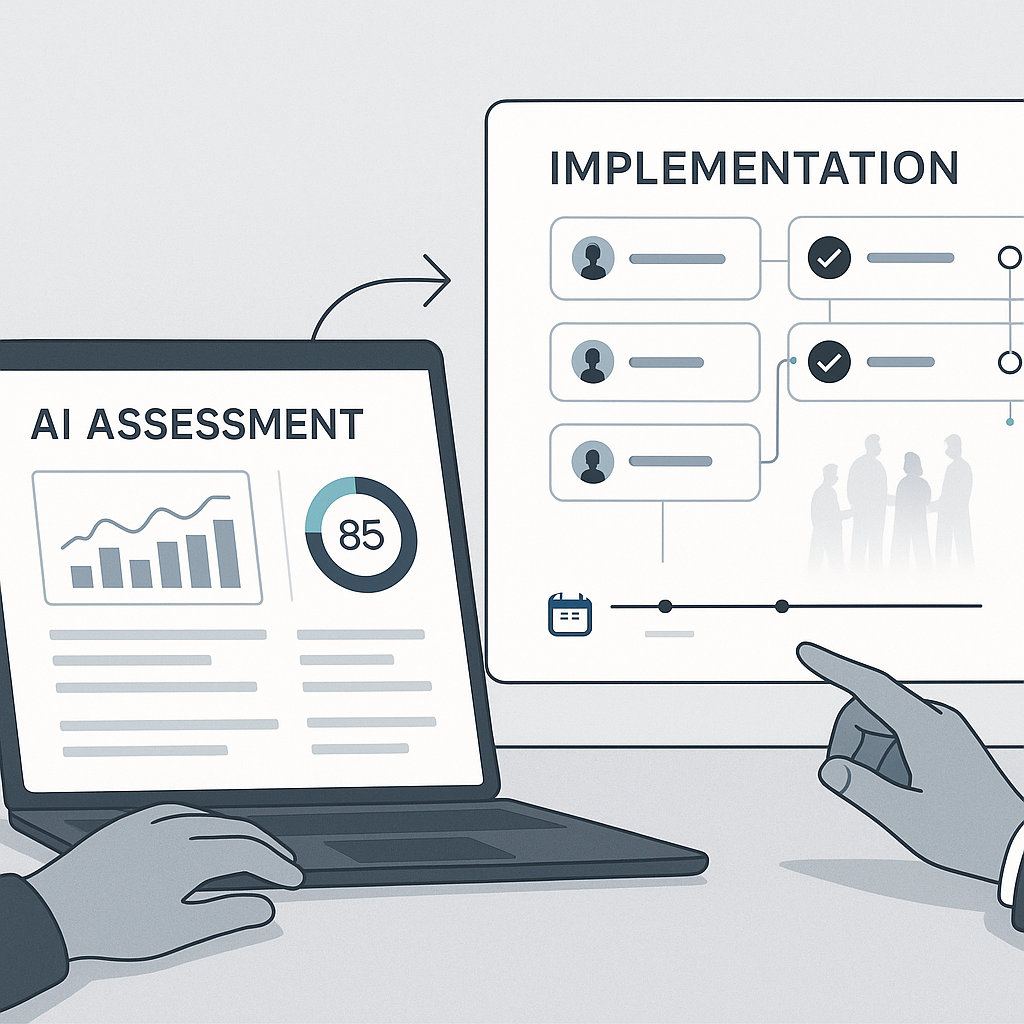
An AI assessment can create the feeling of progress because it leaves behind a clean artifact: a report, a score, a list of ideas, maybe a roadmap.
That still does not mean the business changed anything.
For a small or mid-sized business, the assessment is not the deliverable that matters most. The useful part starts after the report, when someone has to decide what gets tested, who owns it, what needs approval, and what will be left alone for now.
If the assessment does not lead to follow-through, it usually becomes one more document sitting next to old SOP drafts, half-used CRM fields, and project boards no one checks.
The question the assessment should answer is simple: what should we do next, and what has to be true before we do it?
Start with the work, not the polished report
The final report is a summary. It helps, but it is usually not enough to decide what should happen next.
A better follow-through review goes back to the operating details behind the report:
- intake notes
- discovery transcripts
- current tools
- customer-facing workflows
- internal handoffs
- known constraints
- promises made during sales conversations
- places where errors are expensive
That context matters because recommendations often sound cleaner on paper than they do inside a real business.
A report might recommend automated appointment reminders. Fine. Before anyone moves forward, the operator questions come first:
- Where do appointments live now?
- Is the source of truth a calendar, a field in the CRM, or a spreadsheet?
- Who can change an appointment?
- What messages are already going out?
- What happens when a customer replies with a question instead of a confirmation?
- Which cases need a person to step in?
- What mistake would be costly enough that you want review before sending anything?
Those answers tell you whether this is a quick win, a workflow cleanup project, or an idea that should wait.
Reduce the list to the next three moves
Most assessments produce too many possible actions. That is normal. Discovery surfaces options.
The mistake is treating every recommendation like it deserves equal attention.
A practical follow-through plan cuts the list down to the next three useful moves.
Those three should usually include:
- one action valuable enough to matter and small enough to start
- one action that removes a repeated bottleneck or risk
- one longer-term idea that stays conditional on proof
For each priority, spell out a few basic things in plain language:
- the business problem
- the workflow or system involved
- the owner of the decision
- the expected value if it works
- the main dependency or blocker
- the approval needed before it affects customers, records, schedules, or money
This is where the assessment stops being a menu of ideas and starts becoming an operating plan.
A small example:
- Problem: inbound web leads sit in the inbox too long
- Workflow: form submission, inbox triage, CRM entry, callback scheduling
- Owner: sales manager
- Expected value: faster first response and fewer dropped leads
- Dependency: CRM field cleanup and calendar rules
- Approval gate: human review on the first version of outbound replies
That level of detail is usually enough to decide whether the team should act now or wait.
Separate recommendations from implementation work
Assessments stall when advice and implementation get blended together too early.
Advice answers questions like:
- What should we consider?
- What matters most?
- What should we avoid?
Implementation answers a different set of questions:
- What needs to be connected?
- What data has to be cleaned up?
- What scripts, prompts, or rules need review?
- What gets tested first?
- Who maintains this after launch?
Both matter, but they are not the same kind of work.
A recommendation may be directionally right and still not be ready. Maybe the estimate request form is inconsistent. Maybe the call notes never make it back into the CRM. Maybe customer handoff steps live in three different places. Maybe billing codes are too messy to automate safely.
A useful follow-through plan should clearly label recommendations as:
- ready to act on
- needs more information
- needs a business decision
- park for later
That protects the team from pretending they are implementing something when they are still sorting out basic operating choices.
Decide the approval gates before anything goes live
Human review should not be an afterthought.
If a workflow will touch customers, calendars, tickets, invoices, CRM records, or anything tied to commitments, decide the approval gates early.
The right gate depends on the risk.
Examples:
- For customer messages, the gate may be reviewed drafts before sending.
- For CRM updates, the gate may be an exception queue for uncertain matches.
- For estimates or invoices, the gate may be approval by someone responsible for margin and billing accuracy.
- For hiring, medical, legal, or policy-sensitive work, the gate should be strict and explicit.
A follow-through plan should answer:
- Who reviews the first version?
- What evidence do they need to approve it?
- What happens when information is missing?
- What gets logged for later review?
- Who can pause or roll back the workflow?
This keeps the business from creating hidden risk in the name of efficiency.
Use the follow-up call to force decisions
A report handed over without a real follow-up conversation usually goes nowhere.
The next meeting is where analysis turns into commitment.
A useful agenda is simple:
- what we learned from the assessment
- which assumptions changed
- the top three recommended actions
- what we are not doing yet
- what needs approval
- what can be tested in a small pilot
- what success should look like after 30 days
That conversation should not try to push every recommendation through. It should make the next decision easier.
For example, if the team is considering automating intake replies, the follow-up call should settle basic questions:
- Are we trying to reduce response time, reduce admin load, or improve lead qualification?
- Which inbox owns the process?
- Does the first reply offer a scheduling link, ask follow-up questions, or route to a person?
- Who reviews edge cases in the first month?
Without those decisions, even a good recommendation tends to stall.
Make the follow-through workflow repeatable
Once the business has run this review process a few times, the repeatable parts should become a documented workflow.
That could be:
- a checklist
- a follow-up template
- a saved prompt
- a lightweight project board
- a reusable Codex skill
OpenAI's Codex documentation describes skills as packages of task-specific instructions, resources, and optional scripts that help Codex follow a workflow reliably: https://developers.openai.com/codex/skills
If the business wants this review to happen on a schedule, it can later become an automation. OpenAI's Codex automations documentation describes recurring background tasks that can report findings to the inbox and combine with skills for more complex work: https://developers.openai.com/codex/app/automations
For an AI assessment follow-through workflow, that could mean a recurring review that checks:
- open recommendations
- recent client notes
- tool or process changes
- unfinished approvals
- stalled implementation tasks
The output could be a short operator brief sent to the inbox.
The order matters. Run the workflow manually first. Learn where decisions slow down, where data is unreliable, and where a person needs to step in. Then package the repeatable parts.
A practical prompt to start with
If you want a simple starting point after an assessment, use a prompt like this and adapt it to your business:
Review this completed AI assessment, the intake transcript, recommendation notes, current tools, and the client's stated constraints.
Turn the assessment into a follow-through plan.
Prioritize the top three actions. For each one, identify the business problem, expected value, owner, dependencies, human approval gates, likely risks, first test, and 30-day success measure.
Separate the output into: do now, clarify first, needs approval, park for later, and possible future automation.
Draft the agenda for the follow-up call.
That prompt is only a starting point. A person still has to judge tradeoffs, approve customer-facing changes, and decide what is worth the effort.
The real output is a better operating decision
The real output of an AI assessment is not the report itself.
It is a better decision about work:
- what to do next
- who owns it
- what a human must approve
- what evidence will show it worked
- what should become repeatable after the first round of learning
If your assessment does not reach that point, do not ask how to make the report better. Ask what is missing between the report and the first real implementation decision.