From Autoresearch to Decision Labs: How Operators Are Deploying Agent Swarms
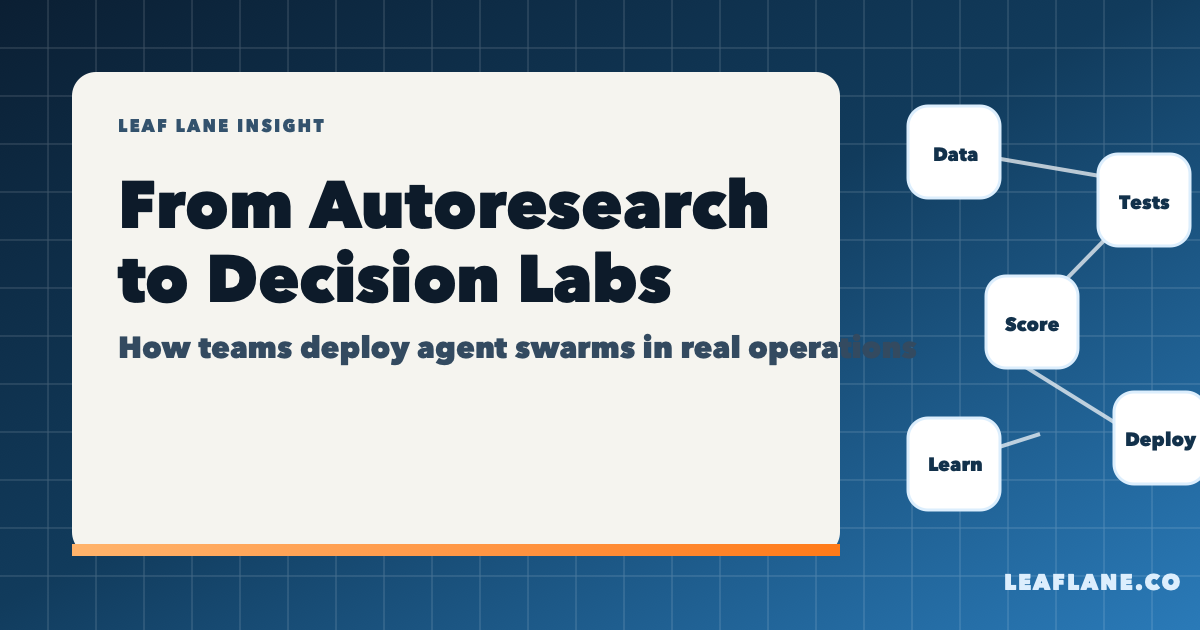
Most teams still treat autonomous research loops like a model demo: interesting, fast, and hard to trust. The more useful pattern emerging in 2026 is operational. Teams are taking the same loop structure and using it as a domain-specific decision lab.
Most businesses do not need more AI output. They need faster, better decisions in places where work already piles up: research queues, market scans, product analysis, portfolio reviews, estimate prep, ticket triage, and internal reporting.
A decision lab is a managed loop, not a clever prompt
A decision lab is not one agent answering one question. It is a repeatable system where multiple agents generate hypotheses, run experiments, score outcomes, and feed results into the next round.
The core loop stays mostly the same across use cases. What changes is:
- the objective you are optimizing
- the evidence the system can access
- the scoring method used to judge output
- the rules for when a change gets promoted
This is why similar architectures now show up in very different settings. One group uses distributed loops for quantitative research and optimization. Another uses related loops for market analysis and portfolio recommendations. Others are packaging the same pattern into workflows for knowledge work and learning experiences.
The shift for operators is straightforward: stop asking whether agent swarms are “real” and start defining the boundaries of a useful loop.
The operating question is: what decision are you improving?
If you want this to work inside a business, start with one decision surface where volume is high and cycle time matters.
Good starting points look like:
- reviewing inbound market or competitor signals each week
- comparing options before a pricing or portfolio decision
- triaging product feedback into themes and next actions
- generating and checking research briefs before a team meeting
- testing alternative plans against a fixed scorecard
Bad starting points usually sound too broad:
- replace analysts
- automate strategy
- run the whole company with agents
The teams getting value are narrowing scope first. They choose one recurring workflow, then add instrumentation around it.
That instrumentation usually includes:
- run history
- scorecards
- failure logs
- approval gates
- rules for updating prompts, policies, or tools
Without that layer, a swarm is just parallelized guesswork.
Evaluation is what turns output into an asset
This is where many implementations break. A swarm can produce a lot of plausible language and still leave the team worse off if nobody can tell what improved.
The loop only becomes useful when each run leaves behind reusable signal:
- what worked
- what failed
- what evidence was weak
- what should change before the next run
That is the real move from prompt quality to decision architecture. Prompting still matters. But the lasting advantage comes from how a team structures experiments, validates outputs, and pushes safe updates into production faster than competitors.
In practical terms, this looks less like “AI replacing work” and more like a supervised review loop attached to real operating artifacts: CRM records, research notes, scoring sheets, internal reports, and handoff documents.
What a 30-day pilot should actually include
If you want to test this pattern, keep the pilot contained.
Use a 30-day setup with:
- one workflow
- one measurable outcome
- one approved data source set
- one human review owner
- explicit promotion gates before any change affects production work
Examples of measurable outcomes:
- shorter turnaround time on research briefs
- better signal quality in market summaries
- fewer low-confidence recommendations passed to a team lead
- higher agreement between agent output and final human decisions
Keep the first version boring on purpose. You want a system that learns under real constraints, not one that looks impressive in a demo.
What the early operator signals are showing
The broader pattern is being discussed by operators working on distributed experimentation, generalized autoresearch, market-focused agent workflows, and low-cost execution stacks.
Source notes:
- Christine Yip (@christinetyip) on early distributed experiment throughput: https://x.com/christinetyip/status/2032267163609022511 and https://x.com/christinetyip
- Varun (@varun_mathur) on generalized autoresearch applications: https://x.com/varun_mathur/status/2032671842230501729 and https://x.com/varun_mathur
- Chris Worsey (@Chris_Worsey) on market-focused agent debates: https://x.com/Chris_Worsey/status/2031821234795659717 and https://x.com/Chris_Worsey
- Andrew Jiang (@andrewjiang) on low-cost autoresearch execution stack: https://x.com/andrewjiang/status/2032364056972325096 and https://x.com/andrewjiang
If your team is exploring this, do not start with the swarm. Start with the scorecard, the evidence boundary, and the review rule. Once those are clear, the loop has a fair chance of becoming a working decision system instead of another unread experiment log.