The Mentor-Protege AI Sprint: A 90-Day Playbook for Small Federal Contractors
Most small federal contractors do not lose because the team is lazy or uncommitted. They lose because opportunities move faster than internal capability building.
A proposal window opens, but prior technical language is scattered across inboxes and shared drives. A delivery team wins work, but handoffs, reporting, and compliance checks still live in ad hoc spreadsheets and calendar reminders. A mentor offers useful guidance, but the guidance never becomes a repeatable workflow.
That is the operating problem.
The good news is that many small firms already have access to a formal capacity-building path. The DoD Mentor-Protege Program and the SBA Mentor-Protege Program are both built to help smaller firms strengthen technical and business capability through structured partnerships. At the same time, AI tools have become cheap enough to support narrow internal workflows without waiting for a large software overhaul.
Put those two facts together, and a practical option appears: use mentor-backed capability transfer and a short internal AI sprint to improve proposal quality, delivery speed, and operating consistency in about 90 days.
Why this matters now
Small contractors usually build capability in sequence. First they pursue partner relationships. Later they clean up processes. Much later they try automation.
That sequence is slow, and it wastes the value of the mentor relationship.
In a March 15 post, Kaia Rhodes (@kaiarhodes) pointed to DoD's Mentor-Protege pathway for firms moving into defense work (source). The useful takeaway is simple: external procurement pathways and internal operating systems should be built at the same time.
Also on March 15, Tom Osman (@tomosman) shared Peter Diamandis' view about designing for abundance economics rather than scarcity assumptions (source). You do not need to adopt the framing to see the practical point. Teams that treat AI as part of day-to-day operations will improve faster than teams that use it occasionally when someone has spare time.
For a small federal contractor, that means using AI where work already bottlenecks:
- proposal drafting and review loops
- compliance artifact retrieval
- meeting notes and action-item follow-up
- contract administration checklists
- program reporting support
- knowledge capture from mentor sessions
What the official programs actually support
These programs are easy to talk about in abstract terms. Operators need the plain version.
DoD's Mentor-Protege Program says it is the oldest continuously operating federal mentor-protege program and frames the effort around helping eligible small businesses expand their footprint in the defense industrial base (source).
SBA's Mentor-Protege Program says small businesses can build capacity through partnerships with experienced contractors. It also states that mentor-protege joint ventures are allowed for small business contracts when the protege qualifies as small (source).
The operating takeaway is direct: these programs are capacity channels.
If your company cannot turn outside guidance into internal SOPs, review gates, reusable records, and trained staff, then most of the value stays in meetings and goodwill. You may gain introductions, but you do not gain durable execution strength.
The right target for a 90-day sprint
Do not start with "AI strategy." Start with a workflow that is painful, frequent, and easy to measure.
Good targets include:
- a proposal workflow where past performance examples, resumes, and compliance language are hard to retrieve
- a delivery workflow where kickoff notes, reporting deadlines, and customer actions get lost across inboxes
- a contract admin workflow where modifications, invoice support, and approvals create rework
- a reporting workflow where staff rebuild the same status update every week from scattered notes
Pick one proposal workflow and one delivery workflow. That is enough.
If you choose six areas, nothing gets implemented deeply enough to matter.
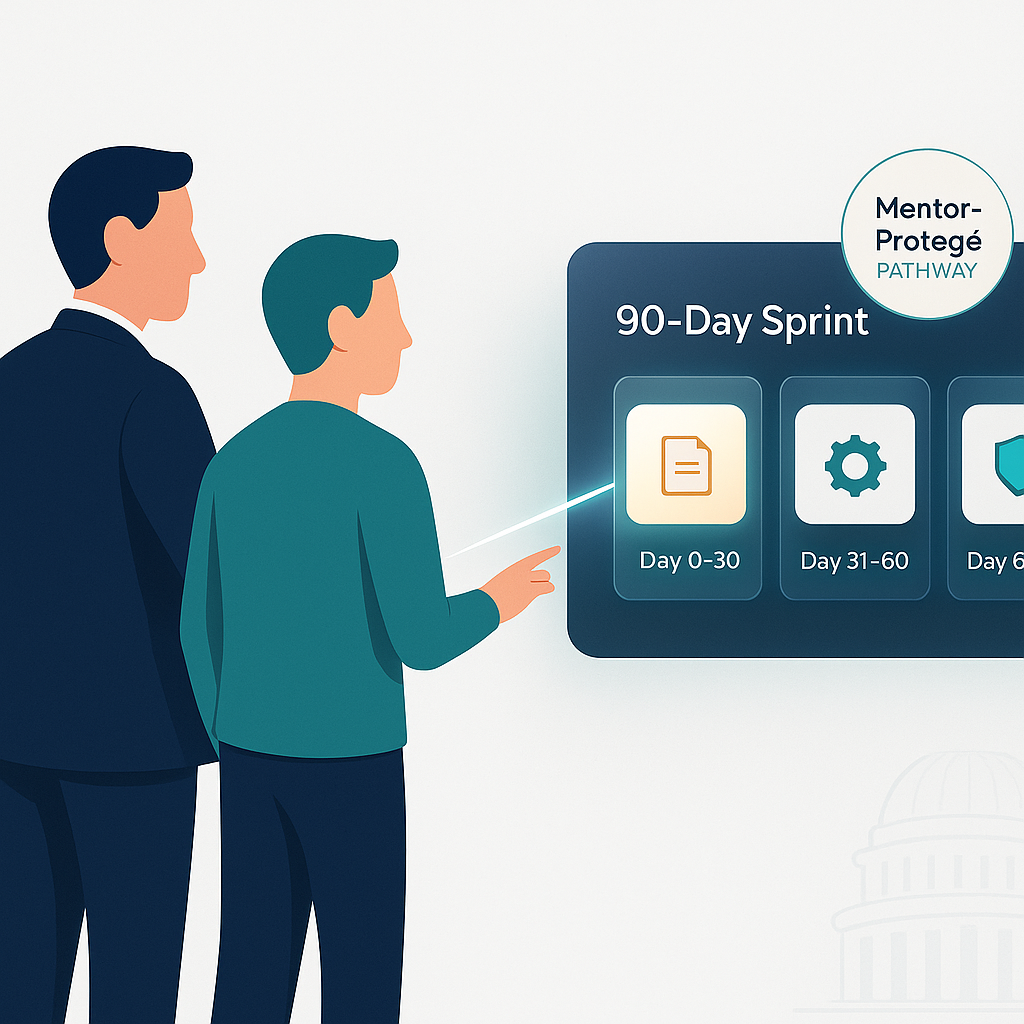
A practical 90-day Mentor-Protege AI sprint
Days 1-15: Baseline the work and set scope
Start with facts, not enthusiasm.
- Pick one proposal process and one delivery process that regularly create delays or rework.
- Measure three outcomes: cycle time, error or rework rate, and throughput.
- Identify where work actually stalls: inbox triage, document retrieval, review approvals, compliance checks, or handoffs.
- Align with the mentor on one technical capability transfer goal and one business process transfer goal.
A useful example:
- Technical transfer goal: improve the structure and evidence quality of past performance writeups.
- Business process transfer goal: create a reusable review rubric and approval flow for proposal sections.
At this stage, your job is to define the lane. Not to buy more tools.
Days 16-45: Build small systems people will actually use
This is where many teams overcomplicate things. Keep the build narrow.
- Create a simple internal knowledge base for prior proposals, compliance artifacts, resumes, technical narratives, and common customer requirements.
- Add AI-assisted drafting or summarization with human approval gates.
- Set a weekly mentor review using a clear scoring rubric for quality, compliance, and readiness.
- Write short SOPs for intake, review, version control, and final approval.
Think in terms of operating parts:
- one place for approved source material
- one checklist for what can and cannot be reused
- one review loop for quality and compliance
- one owner for final approval
For delivery work, the same logic applies.
You might use AI to summarize kickoff calls, draft customer follow-up emails, pull reporting inputs from tickets and notes, or assemble a first-pass weekly status report. But every output should pass through a named owner before it reaches the customer.
Days 46-75: Use the workflow on bounded live work
Now test the system on real work without betting the company on it.
- Use the new workflow on a limited set of proposals, one contract vehicle, or one service line.
- Compare AI-assisted output with the legacy process.
- Track where the new process helps and where it creates risk.
- Update prompts, checklists, and review gates each week.
This is where practical evidence shows up.
Maybe your proposal team cuts retrieval time because technical sections are easier to find. Maybe review comments drop because drafts follow a better structure. Maybe the delivery team sends cleaner status reports because meeting notes no longer disappear into separate inboxes.
You are not looking for perfection. You are looking for fewer misses, less rework, and more consistent execution under deadline pressure.
Days 76-90: Make it repeatable
A sprint only matters if another employee can run the same process next month.
- Publish one internal playbook with workflow steps, approval thresholds, and escalation paths.
- Train at least two additional staff members.
- Define what must be checked by a human every time.
- Choose the next expansion area: proposal writing, capture support, contract administration, or program reporting.
A good playbook is not a long strategy memo. It is a working document that tells people:
- where source material lives
- which templates are approved
- how reviews are scored
- when work must be escalated
- what should never be sent externally without review
Three mistakes that waste the effort
Treating mentor input as advice instead of process design
If a mentor gives feedback on a proposal and your team nods, revises, and moves on, the lesson disappears. If that same feedback becomes a rubric, template, or SOP, the lesson compounds.
Chasing model changes instead of operating reliability
Your goal is not to test every new model release. Your goal is to reduce avoidable errors and deliver compliant work faster. Reliability beats novelty when deadlines are real.
Running AI off to the side
If AI work is disconnected from proposal deadlines, delivery accountability, CRM updates, and review ownership, it will be dropped the first time the team gets busy. It has to live inside actual workflows.
The practical thesis
Small federal contractors do not need a large AI office to improve execution. They need a formal capacity channel and a short sprint that converts guidance into repeatable practice.
Mentor-protege frameworks provide the channel. A 90-day AI sprint provides the mechanism.
If you are in a mentor-protege relationship now, the next useful step is not another general planning session. Pick one proposal bottleneck and one delivery bottleneck, baseline them, and ask a simpler question: what would have to change in our records, reviews, SOPs, and approvals for this work to run better within 90 days?
Source notes
- Kaia Rhodes (@kaiarhodes), X post on DoD MPP context: https://x.com/kaiarhodes/status/2033238275209515399
- Tom Osman (@tomosman), X post quoting Peter Diamandis: https://x.com/tomosman/status/2033307427504844997
- DoD Office of Small Business Programs, Mentor-Protege Program overview: https://business.defense.gov/Programs/Mentor-Protege-Program/
- U.S. Small Business Administration, Mentor-Protege Program overview: https://www.sba.gov/federal-contracting/contracting-assistance-programs/sba-mentor-protege-program